Between the stars
The galaxy map
Section titled “The galaxy map”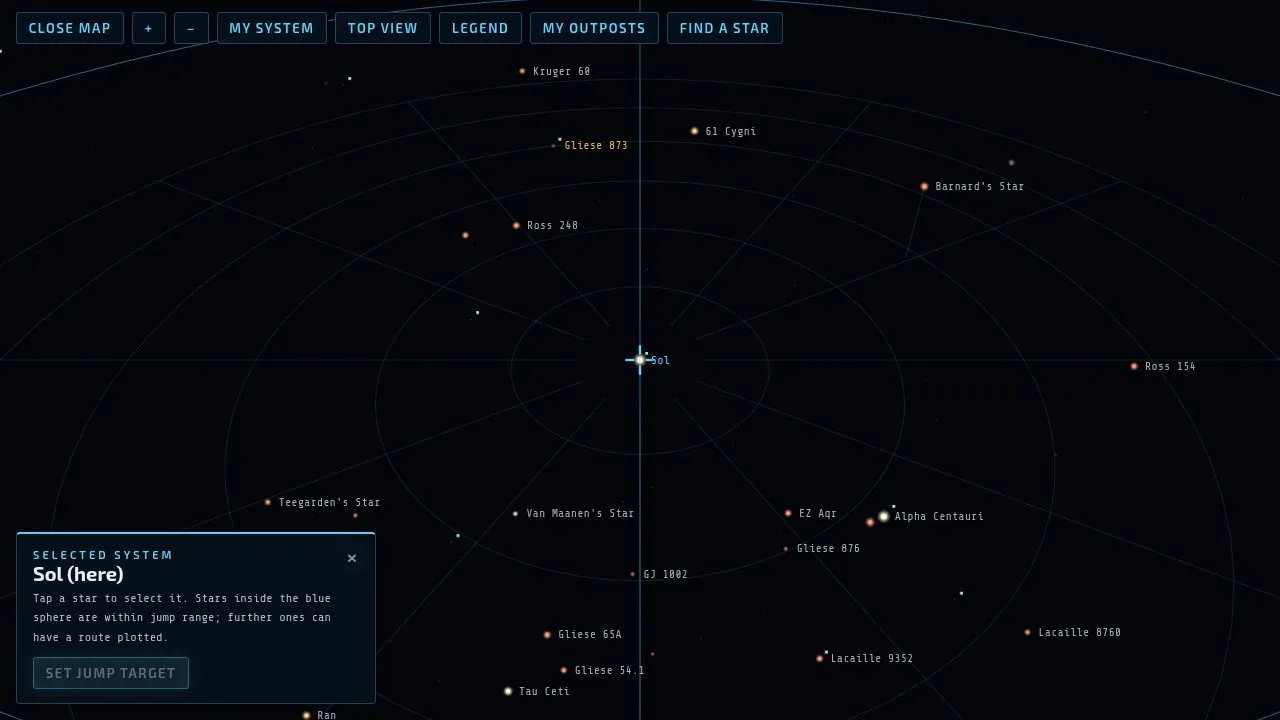
M opens the galaxy map: a 3D map you turn by dragging, pan with two fingers or a right-drag, and zoom with a pinch or the wheel, from the whole galaxy down to half a light year across.
- Stars you can reach in one jump draw brighter, inside a glass sphere showing your jump range.
- Tap a star to select it. The panel tells you about it: what light from Earth shows there, the prices you last saw at its station, whether it has fuel to scoop.
- Find a star searches by name, including the real catalogue’s stars.
- My system brings the view back to where you are.
- Legend explains the marks: stations, missions, party members, exotic stars, rumoured relics.
Stars load as you explore: selecting a star loads the stars round it, so you can push outward a star at a time.
Jumping
Section titled “Jumping”Select a star in range, press J (or Jump), and turn the ship to align with it. The jump costs fuel, and you need to be in open space, clear of the station. While the drive charges, a rift of light opens toward the star in its colour: steer the nose into it and the ship punches through.
Routes
Section titled “Routes”A star out of range can have a route plotted to it, up to 10 jumps. The route takes the fewest jumps, and of those the least fuel, and only stops at stars you can refuel at. Each arrival makes the next stop your jump target.
Your ship carries a fuel tank. Jumps use fuel, and so does just running the ship: a little all the time out of dock, more in supercruise, less landed. Refuel at a station, or scoop it from a star.
Fuel scooping
Section titled “Fuel scooping”Skim close to an ordinary star in supercruise and the scoop fills your tank. Closer fills faster, and the ship heats up, so don’t linger. A worn scoop works slower; overheating wears it.
Exotic stars (neutron stars, white dwarfs and black holes) and brown dwarfs have no fuel to scoop. The galaxy map’s panel says when a star has none.
If a jump would take you to a system with no station and nothing to scoop, without enough fuel left to reach somewhere you can refuel, the game warns you once. Ask again and it jumps anyway.
Jet boosts
Section titled “Jet boosts”Some exotic stars throw out jets. Hold your ship inside a jet for three seconds and your frame shift drive is supercharged: the next jump goes half as far again from a white dwarf’s jet, four times as far from a neutron star’s. The jet heats the ship and wears the hull while you’re in it, a neutron star’s much more than a white dwarf’s.
The real neutron stars are all there, every pulsar astronomers know of with a distance: none is closer than 300 light years. Search for the Vela Pulsar (about 900 light years), Geminga or the Crab Pulsar (about 6,500), or for a pulsar’s catalogue name (“PSR B1257+12”, whose planets were the first found round another star). The generated galaxy has neutron stars of its own too, ones nobody has found.
Expeditions
Section titled “Expeditions”Stations get rare far from Sol: one star in fifty has one out to 500 ly, and past 1,500 ly only one in four hundred, usually several jumps away. Ten landmark stations stand at famous sights out to the far side of the galaxy, and reaching Sagittarius A* at its centre is a milestone of its own. Before a long trip:
- Scoop fuel as you go; you’ll rarely see a station to buy it.
- Carry part repair kits: a broken frame shift drive with none aboard leaves you stranded.
- Sell your exploration data when you can. If the ship is lost, unsold data goes with it, and you wake at the station you last docked at, which may be thousands of light years back.
- A freighter can take an outpost workshop out with you, to build a forward base that mends your ship.
Binary and triple stars
Section titled “Binary and triple stars”About one system in five has two stars, and one in twenty has three. Each ordinary star can be scooped, and on a planet’s surface night falls only when every sun is down.